
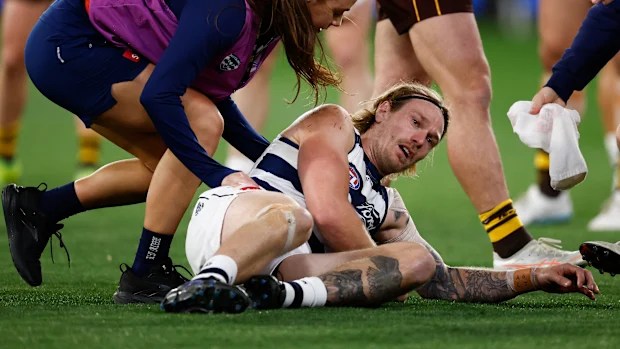
On Thursday, Jay Clark revealed on the Herald Sun site that an AFL player had signed a letter agreeing to waive some of his future legal rights relating to his concussion history – a document neither AFL and AFL Players’ Association claim never to have seen, let alone approved. We have since learnt that the player had been cleared to keep playing by the AFL’s Concussion Panel and that the club in question was Geelong. Within hours the AFL and AFLPA issued a joint statement describing it as a “complex and unique case,” asserting they were satisfied the ‘letter’ had not been used to return a medically unfit player to the field. It also confirmed that Geelong had agreed to strip the waiver from the document while the player’s acknowledgement of ongoing risk remained. Geelong’s own statement, issued through CEO Steve Hocking, conceded the letter “went further than was intended,” attributed its existence to “extensive discussions” between the club, the player, his family and representatives – discussions the club said were informed by both its own chief medical officer and the AFL’s Concussion Panel. Geelong maintained that no direction had been given for the player to retire, nor any attempt made to vary the standard playing contract or sidestep health and safety obligations. No sanction was issued to the club by either governing body.
Where Are The Alarm Bells?
Despite the AFL’s best attempts to play smoke and mirrors in their statement, Geelong has admitted that it did what it had been accused of – attempting to waive its liability in relation to future workplace injuries. At no point had anyone questioned whether Geelong had fielded a player who had been declared unfit to play. Yet, that was the content of the AFL’s response. Reading the statement, one felt a little like they were watching Airplane. When Leslie Nielsen is told that the dinner options on the flight were steak or fish, he responds, “Yes, yes, I remember, I had the lasagna.”
Does the AFL really think we’re all that stupid? That it can just ignore the actual allegations, address something different and then it will all just go away? Maybe they do. Maybe, it will. After all, no one else seems to be questioning their misdirection in the media. Which, if you’ve read Michael Warner’s The Boys’ Club, won’t surprise you – the AFL has spent two decades demonstrating exactly what happens to journalists and commentators who push too hard against it.
Geelong’s admission goes to the heart of an actual work health and safety question, yet no independent regulator has been anywhere near it. Compare that to Adelaide, who in 2018 ran a pre-season camp that drew allegations of psychological harm and was referred to SafeWork SA — an external, independent regulator with no stake in the AFL’s competitive balance or its broadcast deals. That investigation took more than a year, and it ended in the Crows being fully cleared. Geelong, by contrast, has been accused of putting in writing an attempt to shift legal liability for a workplace brain injury onto the employee who sustained it, and the entire matter was resolved within a single news cycle by the two organisations with the most obvious incentive to make it disappear quietly. And the AFL’s own record on intervention tells the same story from a different angle: the intense spotlight on Adelaide resulted in a full external review in the wake of the camp, as random football identities with questionable administrative qualifications spent the best part of a year publicly picking through the club’s culture, coaching staff and leadership.
Where, in this case, is the AFL’s appetite for scrutiny? Where is the demand for an external review of what went on inside Geelong’s football department? It doesn’t exist, because the AFL isn’t in the business of holding a magnifying glass to clubs it has no interest in damaging. After all, at least in part, the AFL is Geelong.
Craig Drummond was, at the time of the incident, President of the Geelong Football Club. He is now the AFL Chairman. That alone is a nuclear-level conflict of interest and should immediately have triggered an independent review of the issue in which both the AFL and Geelong were completely recused and stripped of all decision-making abilities.
Drummond’s might be a governance conflict, but Steve Hocking’s is even worse. Hocking has been Geelong CEO since 2021. Prior to that he ran the AFL’s football operations, match review panel and tribunal system. So he was quite literally the man who used to run the machinery that was supposed to hold clubs like Geelong to account. Anyone else noticing a trend here? In what universe could anyone believe anything the league ever says about the Geelong Football Club?
Is It Finally Time For Change? Unlikely.
Herein lies an opportunity. Not for Geelong or the AFL, but for the fans. Everything above is now a matter of public record: a club that admitted to exactly what it was accused of, a governing body that answered a different question to the one it was asked, a chairman who ran the club in question, a CEO who used to run the very machinery meant to hold him to account. Fodder for real protest is sitting right there, undisputed, in the AFL’s own statements. The only question left is what fans intend to do about it. History suggests the answer is nothing. Partly because they won’t, partly because they can’t.
When it comes to reasons to revolt, Australian Football fans are not poor. It’s death by a thousand cuts, and it has been for thirty years. A fixture that’s been called hopelessly unfair for seasons running, this year copping fresh criticism for a lopsided Opening Round and a wildcard finals system nobody asked for; A stand rule fans have never stopped complaining about since the day it arrived; Umpiring inconsistency that resurfaces every finals series like clockwork; Tribunal outcomes that most cannot make head nor tail of because even though the AFL pretends it is, the tribunal is not independent.
None of it individually is enough to make anyone tear up a membership card. All of it, together, over three decades, is the accumulated evidence of an organisation that has never once had to answer to the people who fund it. Because every year, regardless of what they do to us, attendance and membership numbers go up anyway. There has not been a real financial consequence for AFL House in living memory.
And let’s be crystal clear about something – the only way to send a message AFL House is through their wallet. The whole AFL ecosystem is built on a foundation of sand that looks a lot like fifty dollar notes.
Fans Are Their Own Worst Enemy
If the AFL is a dictator, Australian Football fans are willing subjects. Just take a look at some the immediate reactions after this latest Geelong scandal broke.
Content creator Dan Does Footy was straight onto it. Multiple video posts lamenting the inevitability of Geelong being the club in question. Feigning shock at the AFL’s lack of response but then making light of it just as swiftly.
A post shared by @dandoesfooty
Then there’s the forum comments. A snippet from Reddit (r/AFL):
“Is this really how [Dillon] wants the game to look? What a tepid response. And let us never forget that Ken Hinkley copped a $20,000 fine for pretending to be a plane.”
“It’s actually disgusting how looked after Geelong is by the AFL. Do you think any other club in the league would get a ‘reminder’ for such an egregious breach?”
“Death taxes and AFL House deciding nothing to see when Geelong is involved.”
On the surface it all looks highly critical. But the pattern is instructive, because it isn’t new. It’s the same feckless shrug that follows every AFL scandal — a tribunal decision that doesn’t add up, an umpiring performance that decides a final, a rule change nobody asked for. The reaction is identical every time: outrage for twenty-four hours, a flood of comments, and then nothing. No boycott, no organised pressure, no sustained scrutiny. Fans weep and gnash their teeth, and then they go about their lives, and the next home game sells out anyway.
Is it just not important enough? That’s hard to believe for people who are willing to brave hail and near zero temperatures to watch their team lose by fifty points. Perhaps it’s something deeper. Perhaps it’s the system working exactly as the AFL built it to.
Non-Victorian clubs have had the legal structure of their memberships hollowed out over time, to the point where being a “member” is tantamount to a glorified season ticket – no vote, no say, no actual stake in how the club or the league is run. Even Victorian fans have been engineered out of most formal channels of accountability.
And, it’s worse than fans simply having no seat at the table. Most supporters, faced with no formal channel of their own, would reasonably expect their club to speak for them — to be the body with actual standing to ask the AFL hard questions on their behalf. But clubs won’t do it, because the AFL has spent years making an example of the ones who try. Coaches and officials who criticise umpiring, tribunal outcomes or league conduct publicly don’t get a hearing, they get a bill – please-explain letters and fines dressed up as protecting the game’s image. So it’s not one barrier, it’s two: fans have no say at their own club, and their club has no safe way to have a say with the league. The silence isn’t apathy. It’s been built, one fine at a time. Authoritarianism that’s called.
What’s left, the only lever the average fan actually holds, is the choice to stop turning on the television or showing up at games. And the AFL knows they won’t pull it – because we love the game more than we’re willing to punish the people running it.
Put Up Or Shut Up
None of this is complicated. A club did something it shouldn’t have. A league that exists to prevent exactly that kind of thing looked at it, and chose to look away. That’s not an isolated failure — it’s the system operating as designed, by people who’ve spent their careers inside it, protecting a club one of them used to run. And on the other side of the ledger, a fanbase with every reason to be furious will do what it always does: complain loudly for a day, then buy a ticket for the next game anyway.
To survive, incompetence needs tolerance. The AFL is granted more tolerance by Australian Football fans than it has ever deserved. Until that changes, nothing else will.


Leave a Reply