
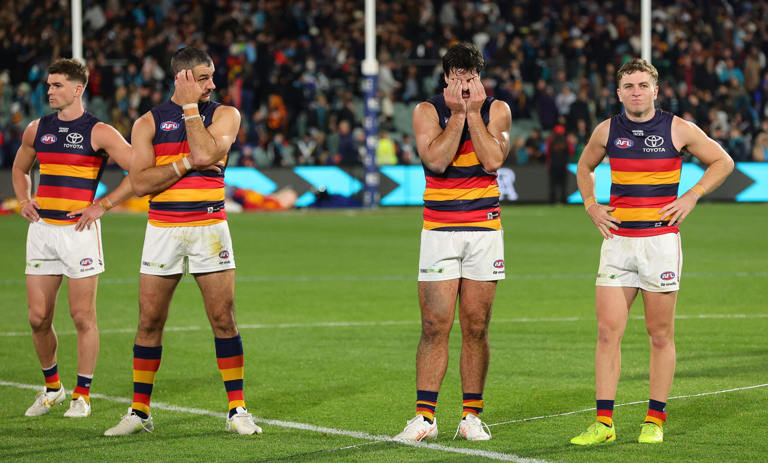
For about forty minutes on Thursday night, Adelaide Oval looked like the launching pad for a genuine premiership statement. The Crows had Collingwood on the ropes early, built a lead of twenty-seven points either side of quarter-time, and watched Taylor Walker bring up his 700th career goal in front of a home crowd that hoped it might be witnessing the start of something beautiful. By full-time, the lead was deformed into a thirty-four-point deficit. Sixteen goals to eleven in favour of Collingwood, ten of those coming after the main break while Adelaide could only manage four. A sixty-one-point turnaround inside a single game of football is not a form slump or a bad quarter. It is a capitulation, and it deserves to be examined as one rather than filed away under the vague, forgiving language of “we’re disappointed but we’ll move on quickly” that dominates Matthew Nicks’ press conferences.
The Mental Side of the Ledger
Adelaide’s problem on Thursday night was not, in the end, a talent problem. Sam Berry continued the breakout season nobody outside the club saw coming, finishing with thirty disposals, seventeen of them contested, and ten clearances, numbers that would headline the best-afield conversation in most games. Arguably, he was every bit as effective as Nick Daicos. Wayne Milera racked up over thirty disposals and more than six hundred metres gained off half-back. The list of individuals who did their job competently is not insignificant: Rankine, Walker, Nankervis, Curtin. What that list cannot explain is how a team with a twenty-seven-point buffer allowed Collingwood to boot ten goals in a half largely unopposed.
That is where the conversation has to move from statistics to something harder to quantify and easier to dismiss: temperament. This is not the first time in 2026 that Adelaide has built a position of dominance against quality opposition and then failed to defend it when the contest turned and the crowd noise shifted. A team that is genuinely built for September football does not need every match to be comfortable, but it does need to be able to absorb a punch without the entire structure of the performance unravelling. Collingwood did not produce anything tactically revolutionary in the second half. They won the collision battle, won the ball movement battle that follows, and Adelaide’s response was to fold rather than fight. A side that intends to be playing finals football in September cannot afford to be this intimidated at home.
Jordan Dawson’s night is worth sitting with a little longer, because it is a smaller version of the same story. The captain was among Adelaide’s best on the final tally and kicked one of the Crows’ eleven goals, and in that opening term, the one in which Adelaide built its twenty-seven point buffer, Dawson was at the centre of almost everything meaningful his team did. He was the release valve under pressure, the outlet who turned scrambled ball into forward-half territory, the sort of composed, elite disposal that a side chasing a flag needs from its leader when the game is still being won on effort rather than execution. What became harder to find as the third and fourth terms wore on was that same imprint on proceedings. Not through any drop-off in work rate, but in the sense that Adelaide’s captain became a passenger to the pattern rather than an author of a response to it, unable to manufacture the sort of individual moment that drags a contest back from the brink the way genuinely elite captains are able to when their team needs it most. The shape of Dawson’s influence on Thursday night, decisive early and increasingly peripheral late, mirrors the shape of the result itself far too closely to be a coincidence. Jordan still gets a pass this year for reason that don’t need to be explained any further. But his teammates shouldn’t get off so lightly.
Fogarty’s Absence Was the Difference, Again
It has been a running theme on this blog that Darcy Fogarty’s value to this Adelaide side is consistently underpriced by an audience that only notices him when the goals are piling up. Thursday night made the opposite case with uncomfortable clarity: Fogarty’s absence, not his presence, was the story, and the trend of Adelaide’s season quietly turning on whether he is in the side is now impossible to ignore. Suspended for merely playing football against Sydney’s Harry Cunningham a fortnight ago, Fogarty watched from the player box as Taylor Walker kicked three including his career milestone. But one admirable performance from a smart, well-credentialled forward is not a like-for-like replacement for the contested marking target, the hold-up presence, and the second and third efforts inside fifty that Fogarty has been quietly providing for years. Adelaide’s forward line without him looked exactly like what it was: a unit missing its muscle, leaning on Riley Thilthorpe to do far more than, frankly, he is capable of at the moment.
The frustrating part of this pattern for Adelaide fans is that it’s a familiar script. Rankine last year, Fogarty this. Sadder still, there are still those out there that believe that Rankine is the only player ever to have used a word he shouldn’t have in the heat of battle. Four weeks for what is tantamount to swearing is laughable. Three weeks for simply tackling a guy is even worse. I guess there’s a reason Adelaide are one of the most punished teams in the league. But thanks to a spineless leadership from CEO through the board down to the coaches – nothing ever gets questioned or called out. Adelaide Football Club employees are champions of toeing the line, deathly afraid of biting the hand that feeds but also oppresses.
Turning The Mentality Around
Adelaide need to start embracing the villain tag the league and its lapdog media seem determined to pin on them. It has to be Us versus Them. This is a decades-old concept in South Australian football, the upstarts against the establishment, the agitators refusing to play nice with a competition that has never quite known what to do with them. So, Adelaide, get angry. Get even. Take what is theirs. Steal the cup they think belongs to them by right. Believe in yourselves, because right now nobody else does. Even your own fans waiver after twenty eight years of almosts.
Every team needs a who, where, what, when, how and why to win a flag. The where, what and when take care of themselves, dictated by a fixture and a finals system Adelaide has no control over. The variables that actually decide a premiership are the who, the how and the why. Adelaide have their who, a list good enough to be sitting in the top four in July. They have their how too, a game style built on pressure and contested football that took them within reach of preliminary final last year. What they still need, and what will decide whether any of it amounts to something in September, is a why. Belief and success only start flowing once that last piece is found.
The absence of a why was laid bare on Thursday night. They had nothing to pull from when the chips were down. So, try a chip on your shoulder and make that your why. Stop accepting the narrative that’s shoved down your throat. Made from SA? The team for all South Australians? Fucking play like it.
At the end of the day – this is a mighty club built on the foundations of over 160 years of football tradition. Collingwood is just a tiny suburb in Melbourne.


Leave a Reply