
Port Adelaide’s 26-point dismantling of the Crows on Saturday night was, on its surface, the kind of result that writes its own narrative. Fifteenth-placed underdogs stun fifth-placed favourites. Zak Butters wins the Showdown Medal. The AFL content machine whirs into life. By Sunday morning, the story had already been neatly packaged and distributed: two irresistible midfielders, a shocked and flatfooted Adelaide, and a result that proved — yet again — that the Showdown defies form and logic. Bread, as we have noted here before, and circuses.
But Showdown 60 was a more complicated game than that tidy narrative allows, and Adelaide’s failures were more specific and instructive than a simple 26-point hiding suggests. What follows are six observations that the scoreboard, and much of the post-match commentary, did not particularly illuminate.
The Ruck Story Was More Interesting Than Hitouts Alone
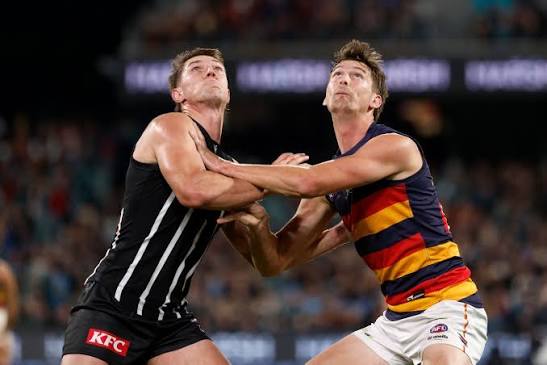
Jordon Sweet won the hitout count, as he did last time the two teams met, and as he was always likely to in a match against a ruckman playing his 17th game. The commentary largely nodded at this and moved on, filing it under evidence of Port’s dominance. But Lachlan McAndrew — the former rugby union convert who arrived at the Crows through one of the more unlikely sliding-doors moments — was, in almost every other measurable dimension, the better ruckman on the night.
McAndrew’s work in the contest beyond hitouts – his tackling, his disposal efficiency and his general craft around the ground told a story that raw tap counts simply cannot. Sweet’s hitout advantage is real and not to be dismissed, but treating hitout numbers as the primary lens through which to judge ruck contests in 2026 is a bit like judging a midfielder by possession count without asking where those possessions went — which, as it turns out, is a rather apt comparison for another observation to come.
Zak Butters Had a 51% Disposal Efficiency. Read That Again.
The consensus from commentators and social media alike was that Zak Butters produced one of the great individual Showdown performances — 37 disposals, 13 clearances, Showdown Medal, full stop. The problem with that summary is the detail it quietly buries: a disposal efficiency of 51%, meaning roughly half of those 37 touches went, in some meaningful sense, nowhere useful. And of those 13 clearances that generated so much excitement, only five were centre bounce clearances. The other eight came from stoppages around the ground — important, certainly, but not quite the engine-room dominance the highlights reel implied.
None of this is to say Butters had a bad game. Thirteen clearances in any form is a significant output, and his ability to impose himself physically on the contest was evident throughout. But the portrait being painted — that Butters was operating at some kind of transcendent level, tearing the Crows apart with a combination of power and precision — does not quite survive real analysis. What he provided was volume, physicality and some genuine match-winning moments. The precision, at 51%, was not there. That distinction matters if you are trying to understand what actually happened.
Jason Horne-Francis Also Had a 51% Disposal Efficiency
This point needs to be made plainly, because the post-match narrative pinned Adelaide’s evening almost entirely on the Butters-Horne-Francis axis as though the pair were operating in concert at some elevated level above the rest of the game. Horne-Francis, like Butters, finished at 51% disposal efficiency. The two of them combined for the majority of Port’s clearance dominance, and Port won the contested possession count by a margin of six — but Adelaide actually won the uncontested possession count, which is a detail that tends to disappear entirely in the official story of the match. Port’s midfield was manic and deserves credit for that. It did not, however, produce some masterclass in quality and execution. Because despite Horne-Francis and Butters combining for 35 contested possessions, only half of them found a target and as a team Port Adelaide only won that count by six.
Darcy Fogarty’s Five
Darcy Fogarty kicking five goals on Saturday night was framed as a pleasant subplot — a returning forward finding his feet after injury, a silver lining in an otherwise dark evening. What that framing misses is that Fogarty’s performance was not an aberration from his usual game. It was his usual game. Fogarty is, with some consistency, a forward who provides the kind of patient, intelligent, hard-bodied presence in the forward fifty that Adelaide’s more celebrated names in that half of the ground often fail to replicate. Fogarty averages 5 contested possessions per game this season. Benchmarked against other forwards, that’s rated above average. His 16 disposals and four marks on Saturday were also not anomalies — that is simply what Fogarty does. This was a trademark Fog performance, albeit a little more accurate. Thanks to the largely shallow nature of AFL commentators, the spike in accuracy made for an easy, lazy narrative of “Fogarty is so much better tonight.” Yet, on nights when the goals do not flow as freely, Fogarty does everything else he did on Saturday and receives a fraction of the recognition. His importance to this side extends well beyond the scoreboard on any given week, and the sooner that is understood by the people covering this team, the better served Crows supporters will be.
Murray and Milera Hurt
Nick Murray did not play on Saturday night. Neither did Wayne Milera. Milera was injured and unavailable. Murray was dropped. Matthew Nicks made the call to go into a Showdown — against a Port Adelaide side built around aggressive small forwards and hard-edged contest pressure — without one of his most physical and defensively combative players, and that decision deserves more scrutiny than it has received in the post-match wash-up.
Murray provides something that statistics only partially capture: a physical presence at defensive contests, genuine desperation at the ball and the kind of hard-nosed accountability that makes life difficult for opposition forwards. In his absence, and with Milera already ruled out, Adelaide’s backline lacked the grunt to absorb what Port’s forward setup was always going to bring. James Borlase drew some favourable commentary for a couple of decent intercept marks, but the complete picture of his evening was one of a defender who was comfortably managed more often than the highlights suggested.
What’s most interesting about this is that Adelaide had more Rebound 50s but fewer inside 50s. Which tells you the quality of ball use from defence was not at its usual marker. That’s Milera. And also a Mark Keane performance that brought him back down to earth after a stellar return from injury last week.
Further, despite only winning Inside 50s by seven, Port’s ability to generate scores once in there was far superior. They scored in over half of their entries. That’s Murray. Sometimes a presence is as useful as a statistic.
Nicks will have his reasons for the Murray omission. But in this game, against this Port side, with Milera already gone, it looks like a misjudgement — and it is one worth naming plainly.
Izak Rankine’s Night Was Not Acceptable, Regardless of the Injury
Rankine left the ground in the first term with a suspected ankle injury after being caught in a Butters tackle, and his limited involvement from that point — twelve touches for the evening — was partly attributed to the knock. That context matters, but it does not fully explain the lack of impact that Rankine provided in the time he was on the ground. For a player of his ability, of his speed and creativity and capacity to change a game in the space of one disposal, twelve touches that barely registered on the contest represents something more than an injury excuse. There is a version of an injured Rankine that still finds the ball, still causes chaos, still forces the opposition to think about where he is. Saturday night was not that version, and, if declared fit by the medical room, Adelaide will need a lot more from him in the weeks ahead.
Before Showdown 59, we wrote here that the Showdown’s real value to the AFL lies precisely in how neatly it packages South Australian football into a content-friendly rivalry product — one that redirects energy sideways rather than upward. Saturday night was another example of that machinery at work. A 15th-placed Port Adelaide side dismantles a top-five Adelaide, and by Sunday the story is Butters and Horne-Francis and the magic of the Showdown. Couple that with another deliberately vague press conference from Nicks, and rather than a pointed examination of why Adelaide’s selection decisions, injury management and defensive structure left them exposed, Adelaide fans get left in the dark.
The Showdown gives everyone an easy story. The job of anyone who actually cares about the Adelaide Football Club is to look past it. Because what should still matter more is premierships, and opponent aside, that game was a very concerning moment for Adelaide’s 2026 flag campaign.


Leave a Reply