
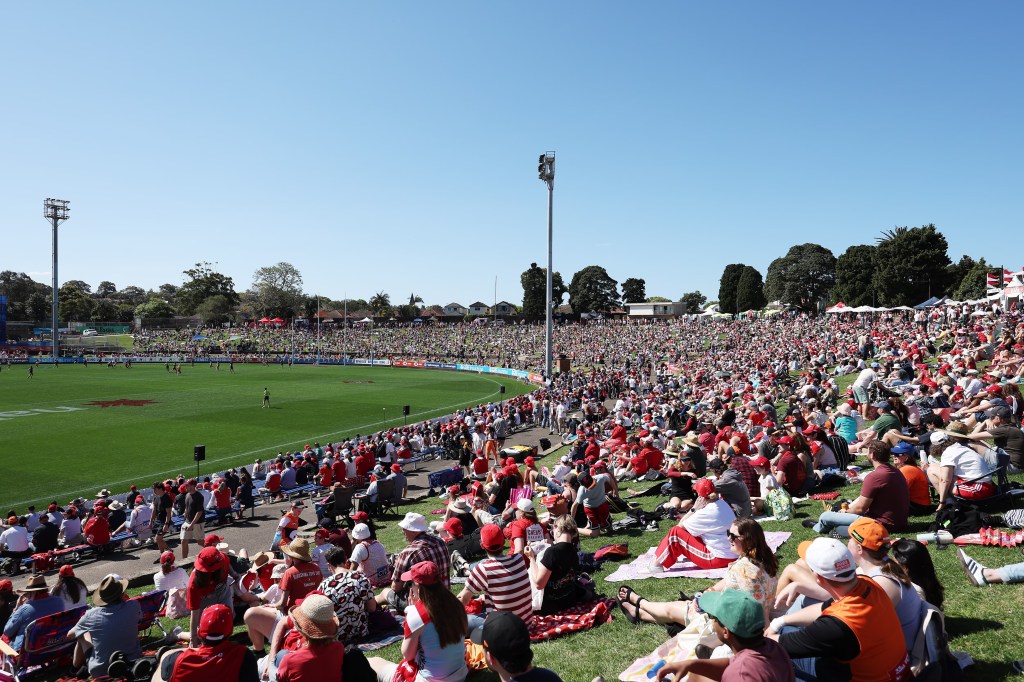
Every February, the Australian Football League sends its clubs to suburban ovals and regional grounds under the banner of the Community Series. The messaging is consistent: taking elite football to new audiences, strengthening grassroots ties, growing the game nationally. Is that the real reason though?
The Motive Question
Why does the AFL stage preseason matches at venues that are, by its own standards, second-tier?
The outreach argument is losing water. Never before have regional fans been better situated to see their teams up close and personal. Besides, any actual community engagement that occurs concurrent with these games is organised and executed by the clubs, not the league.
The AFL is not merely a custodian of sentiment. It is a commercial enterprise with political relationships and public funding arrangements to maintain. A fixture list that includes Ballarat, Madurrah or Morwell is useful evidence when the league speaks about its national footprint. It reinforces the idea that the AFL serves all Australians, not just the major metropolitan centres.
The Community Series provides the AFL a convenient signpost it can point to when it claims it is “growing the game”. It provides genuine community engagement that the league can claim credit for but not stump up for.
The tension lies in how much growth actually occurs.
A preseason match at a regional ground does not alter the distribution of prime-time fixtures. It does not shift the centre of power within the competition. It does not materially rebalance infrastructure investment or competitive advantage. It is an outreach exercise, not structural reform.
The Timing
If the Community Series is about outreach, it should be treated as such. Instead, it currently carries the label of official preseason preparation.
Clubs are asked to prepare for a season on grounds with limited capacity, varying surfaces and pared-back broadcast standards. Coaches manage minutes cautiously. Supporters are told these fixtures matter, yet everyone understands they are controlled exhibitions.
There is a cleaner approach available.
Instead of skirting their responsibilities, the AFL could legitimise the preseason schedule by shifting Community Week to the first week of games, replacing the rather pointless match simulations. A touring roadshow through regional and suburban venues, with the focus squarely on engagement and visibility, is a good way to ease people back into footy. The second week could then shift to established AFL venues, offering clubs a more authentic rehearsal and supporters a more serious contest.
Such a structure would not diminish the community component. It would clarify it. Week one would be outreach. Week two would be preparation.
At present, the AFL tries to merge both purposes into the same limited window, and the result satisfies neither entirely.
It seems at least plausible that the reason the AFL has recently favoured match simulations in the first week of preseason is that they don’t come with a price tag. Perhaps, at least initially, there was a sense of post-COVID trepidation to navigate. That won’t wash six years later.
The Money (Always Follow The Money)
The discussion inevitably returns to cost.
The AFL’s broadcast deal from 2025 to 2031 is valued at approximately $4.5 billion. In that financial environment, it is difficult to accept that staging a clearer, two-week preseason structure is beyond the league’s means.
The official two-game preseason format was trimmed in part because it was considered inefficient. Yet the league now operates with unprecedented revenue. If the Community Series is genuinely central to its growth strategy, it could invest more heavily in the quality of those matches while still providing a meaningful second week at major venues.
Instead, the current model feels like a compromise born of thrift. Community outreach is compressed into a limited fixture. Competitive preparation is diluted. The league retains the ability to cite regional engagement, but without committing to a broader structural expansion.
Furthermore, the week before preseason games commence, a number of clubs take their intraclub matches out to the community. This costs the AFL nothing, yet they’d probably point to it as a marker of their commitment to growing the game.
Outreach or Optics?
None of this is to deny the value of professional football appearing in regional towns. For those communities, the experience is real and deserved. The other side of that coin though, is the fans in cities, who quite literally prop this league up. Do they not deserve any quality preseason fixtures? If you love Australian Football – it’s a long four months waiting for its return.
The question is whether the league is content with symbolic reach, or whether it intends to pursue substantive change. A preseason match in a country centre is a welcome gesture. It is not, by itself, a transformative growth policy.
If the AFL wishes to continue presenting the Community Series as evidence of national expansion, it should separate community theatre from competitive rehearsal and fund both properly. In a competition with billions secured in broadcast revenue, the issue is not capacity, it is intent.

 Thebarton Enquirer
Leave a comment