
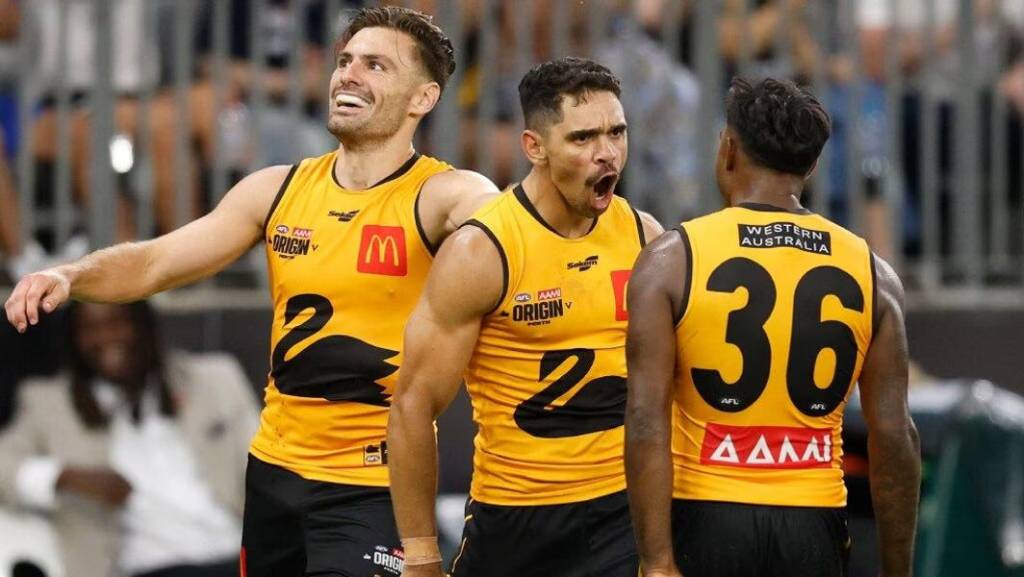
State of Origin last night made a triumphant return. Let’s call a spade a spade though, the AFL never does anything out of sentiment. So it seems pertinent to stop and think – why now?
For whatever reason, Origin has all of a sudden become commercially viable for the AFL. That doesn’t mean it can’t be compelling. It doesn’t mean the players don’t care. And it doesn’t mean supporters won’t lean forward when the state jumpers clash again.
Thebarton Enquirer is a reader-supported publication. To receive new posts and support my work, consider becoming a free or paid subscriber.
But if we’re going to have an honest conversation about Origin’s revival, we should probably start with why it died in the first place.
Why Origin Really Disappeared
Origin was born of interstate play that had been happening since the early days of Australian Football 150 years ago. It was a long-standing tradition, and it’s death should never have been taken so lightly.
The official explanation was always neat and reasonable.
Professionalism loomed.
Contracts got richer.
Clubs didn’t want to risk injuries.
Fans lost interest.
Most of that is true in varying degrees — but it’s an incomplete picture.
First and foremost, State of Origin faded out because the league’s priorities shifted. You can say that people lost interest, but if you’ve taken all the oxygen out of it, then why should it be a surprise that people lost interest?
Of all the official reasons for it’s disappearance, coach’s opinions about player injuries endures at the top. And let’s take a moment to consider the implications of that. If coaches decided they didn’t want their stars being hurt in a non-premiership points game, the implication is that the AFL premiership had become more important than State of Origin.
If that’s true – did anyone ever stop and ask if that reflected the will of the fans? All the fans.
In the early 90s, once the competition transformed from a Victorian league with interstate participants into a national competition with national broadcast ambitions, state tribalism became awkward for the AFL.
Interstate play thrived when Australian Football remained largely decentralised, before the narrative was manipulated to falsely paint Victoria as the traditional home of the sport. While the Australian National Football Council still reigned, state matches were hearty affairs played for pride. State of Origin was born out of fairness. It was campaigned for primarily out of Western Australia to stop Victoria using players from other states – who’d taken lucrative VFL contracts – to bolster their state teams.
Once the AFL rebranded itself as a unified national competition, the only way it was going to be able to justify the Victorian-ness of the league was some good old fashioned smoke and mirrors. In this way, Origin presented an uncomfortable problem. If fans continued to be presented with state based tribalism, sooner or later even the stupid ones would start asking questions about why the so-called national league was so Victorian.
Origin lays bare the fact that Australian footballers come from everywhere. It shows that the game is Australian, not just Victorian. Simultaneously, it draws attention to the fact that the AFL have continued to give Victorian clubs a bigger piece of the talent pie through a horrendously imbalanced national draft system.
So really, it’s not all that hard to understand why the AFL was so keen to see the back of it in the late 90s.
The “Player-Driven” Narrative
The most interesting part of the relaunch hasn’t been the football — it’s been the framing.
We’re told this revival is purely player-driven. That it grew organically. That the boys wanted it and who were we to stand in their way.
I don’t think anyone doubts the players’ enthusiasm. But it’s also not new. The players have generally always been behind Origin. They were not a reason it died and they’ve never really been a road-block to its revival. To suggest so is disingenuous.
No initiative of this scale lands on the AFL calendar without broadcast modelling, sponsorship alignment, insurance sign-off and commercial forecasting. The modern AFL does not stumble into marquee events.
Positioning Origin as player-led performs two functions:
- It shields the league from accusations of commercial opportunism.
- It frames any scepticism as anti-player sentiment.
It’s clever. And it works. And it’s a tactic they’ve been using for decades. Next time you watch a replay of the iconic 1994 Origin game between South Australia and Victoria – pay close attention to the “Name Of The Game” banners in the crowd and ask yourself – what was that campaign really about?
If fans now question the timing, they’re subtly nudged toward feeling like they’re dismissing something the players themselves have embraced.
But professional sport at this level doesn’t move on sentiment alone.
When Football Becomes a “Product”
During coverage and commentary, Origin has frequently been described as a “great product.”
Football used to be described as a contest, a rivalry, a spectacle. Now it is inventory. Content. A product.
This isn’t accidental language. It reflects how the league views the game — as programmable premium content within a broadcast deal worth billions. Put simply, the AFL sees Origin, and the game at large, as something they own that they have the right to sell to us.
Even a cynic like me can accept that the AFL is a commercial enterprise and money has to be generated to put on the show. But when administrators and commentators lean too comfortably into “product” language, it confirms what many supporters suspect: sentiment comes second to monetisation.
Origin’s revival fits neatly into that framework. It generates new sponsorship inventory. It sells new merchandise. It fills a pre-season ratings window.
Romance is powerful, but revenue is reliable. Put another way; fans love the game, the AFL loves the dollar signs.
And if anyone believed that all that money the AFL makes was being used to improve the game, then it could all be excused. But I don’t think Australians are that gullible.
Why Now?
This is the lingering question.
Why 2026?
The AFL calendar has never been more structured, more controlled, more optimised. Nothing enters it casually.
The competition faces:
- Mid-season content fatigue
- A crowded sporting landscape
- Increasing broadcast expectations
- Constant comparison to the NRL’s authentic State of Origin – games that are ideological first, commercial second.
Reintroducing an event with built-in nostalgia and interstate tension solves multiple commercial challenges at once. Origin isn’t being revived because the players were so loud they couldn’t be ignored. It’s being revived because the model demanded innovation.
And nostalgia is one of the safest innovations available.
The Victorian Undertone
There was another layer during coverage — one that long-time interstate supporters would have noticed.
The framing often drifted toward Victoria as the owner-incumbent. At times, it was less than subtle. Western Australia was consistently belittled and patronised by the commentators who did nothing to temper their Victorian parochialism.
References to tradition.
To custodianship.
To heritage.
On paper, the argument could certainly be made that Victoria was a stronger side, and a four goal win felt about right. Commentary around WA ‘putting up a fight’ in the context of this game would have passed the pub test. But it strayed far from that – into discussions that did everything but suggest that the reason Origin hadn’t been revived until now was disbelief that anyone could ever match the Big V’s supremacy. It was arrogance of the highest order. But then, you put that many over-inflated egos in one room, you’re bound to get some arrogance.
If Origin is to mean something beyond 2026, it can’t quietly default to a narrative of Victorian birth right. A truly national game can’t operate with an inherited hierarchy.
The Honest View
It was compelling. It carried energy. It produced moments that cut through the weekly rhythm of the premiership season.
But let’s resist the temptation to pretend its return was inevitable or purely sentimental.
The AFL does not resurrect traditions out of nostalgia alone. It evaluates assets.
Origin is back because it fits the commercial ecosystem. The players may love it, the fans may love it. But those will not be criteria the AFL uses to decide if it stays or goes.
That they were unwilling to commit to anything more than a one-off game this time around tells you all you need to know.


Leave a Reply